
Claims Against Government Entities: Understanding California Government Claims, Federal Tort Claims, and Your Rights
Injury claims against government entities are governed by special statutes, strict deadlines, and procedural hurdles that do not apply in ordinary personal injury cases. If a government agency, employee, or public vehicle caused your injury, you must follow the California Government Claims Act (for state or local agencies) or the Federal Tort Claims Act (for federal agencies). Failure to meet these deadlines almost always results in your claim being permanently barred.
BLG specializes in representing clients injured by government negligence—including police collisions, unsafe public property, ambulance and fire department negligence, USPS vehicle crashes, and federal employee misconduct.
California’s Government Claims Act (Gov. Code § 810 et seq.) requires claimants to file a Government Claim Form within 6 months of the injury before filing any lawsuit.
This step is mandatory, even if liability is clear.
A. Who Is Covered Under the California Government Claims Act?
The Act applies to:
- City governments (Los Angeles, San Diego, etc.)
- County governments
- State of California agencies
- School districts
- Fire departments
- County EMS/ambulances
- City police departments
- Public hospitals and medical centers
- Public universities (UC, CSU)
- Public employees acting within the scope of employment
B. Common Examples of State/Local Government Negligence Cases
These cases commonly involve:
- Police vehicle collisions
- Ambulance or fire engine crashes
- Dangerous public property (sidewalks, streets, lighting)
- School injuries (negligent supervision)
- Bus accidents (LA Metro, city transit)
- Slip/trip on public premises
- Falling trees on city property
- Unsafe government buildings
- Negligence by county hospitals or clinics
C. Filing Requirements (California Government Claim)
- Claim must be filed within 6 months of the injury (Gov. Code § 911.2)
- Government entity has 45 days to accept, reject, or ignore the claim
- If rejected, you have 6 months from the rejection to file suit
- If no response within 45 days, you have 2 years from the date of injury
If you miss the 6-month deadline, you must file an application for late claim relief, which is discretionary and often denied.
D. Applicable CACI Jury Instructions
Commonly used jury instructions include:
- CACI 400/401 – Negligence
- CACI 406 – Comparative Fault
- CACI 430 – Causation
- CACI 1100–1123 – Dangerous Condition of Public Property
To prove a dangerous condition, a plaintiff must show:
- The property was in a dangerous condition
- The condition created a reasonably foreseeable risk of injury
- The public entity had actual or constructive notice
- The entity had enough time to fix or warn about the condition
If the negligent party was a federal employee, federal law—not California law—applies.
The Federal Tort Claims Act (28 U.S.C. § 1346(b)) allows citizens to sue the United States for injuries caused by federal employees acting within the scope of employment.
A. Who Is Covered Under FTCA?
Common federal agencies include:
- United States Postal Service (USPS)
- Veterans Affairs (VA hospitals, VA doctors)
- Federal Bureau of Prisons
- Border Patrol / ICE
- FBI agents driving government vehicles
- Federal courthouses and offices
- TSA, FAA, federal airport personnel
- Social Security Administration
- Federal employees driving government fleet vehicles
B. Common Federal Tort Examples
- Postal truck collisions
- Medical malpractice at VA hospitals
- Slip/trip on federal buildings
- Negligence by federal officers
- Vehicle accidents by federal workers
- Negligent security at federal facilities
- Federal employee misconduct causing harm
C. FTCA Filing Requirements
Federal claims follow a completely different procedure:
1. File Standard Form 95 (SF-95)
Before any lawsuit, you MUST file an administrative claim with the federal agency.
2. Deadlines
- 2 years from the date of injury to file the SF-95
- Government has 6 months to accept or deny
- If denied or ignored after 6 months → you may file a lawsuit in federal court
3. Where Is the Lawsuit Filed?
- All FTCA lawsuits must be filed in federal district court
- State court filing is not allowed
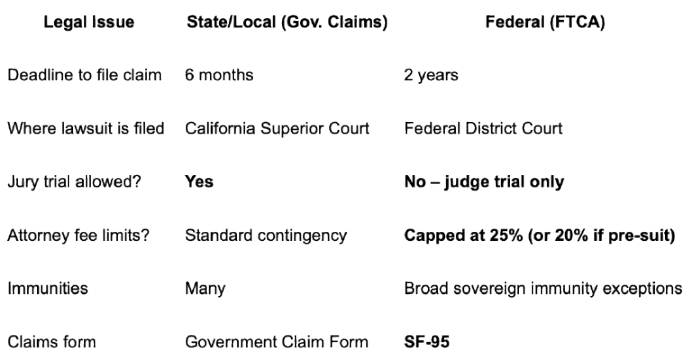
D. Major Differences Between FTCA & California State Claims
E. FTCA Attorney Fee Restrictions
Federal law caps attorney fees at:
- 20% if resolved administratively
- 25% if lawsuit is filed
This is mandatory and cannot be increased.
F. Damages Under FTCA
- Medical bills
- Lost wages
- Pain and suffering
- Property damage
- Wrongful death
Punitive damages cannot be recovered against the federal government
State/Local (California Government Claims Act)
✔ City police departments
✔ County sheriffs
✔ Fire departments
✔ Ambulance/EMS services
✔ Public hospitals (County/State)
✔ Public schools / school districts
✔ DMV
✔ State Parks
✔ Caltrans (roadway defects)
✔ City transportation (Metro buses)
Federal (FTCA)
✔ USPS
✔ VA medical centers
✔ Federal prisons
✔ TSA/airport federal personnel
✔ FBI, DEA, ATF
✔ Federal courthouses
✔ Social Security Administration
✔ ICE, Border Patrol
✔ CDC, FDA field offices
State/Local Examples
- LAPD patrol car runs a red light and hits you
- You fall due to a broken city sidewalk
- A county paramedic negligently injures a patient
- Fire truck collision
- School playground negligence
- City bus accident
Federal Examples
- USPS mail truck rear-ends your vehicle
- Slip and fall inside a federal post office
- Medical malpractice at a VA hospital
- Border Patrol vehicle accident
- Federal employee causes injury on duty
Absolutely—government liability cases are procedural traps for unrepresented claimants.
Yes—many immunities exist; analysis required.
Yes, but accuracy matters—use a lawyer.
You may have to file multiple claims.
Yes, both state and federal allow it.
Not required but highly helpful.
State: 45 days. Federal: 6 months.
VA malpractice claims fall under FTCA.
Not for active-duty injuries (Feres doctrine).
Depends on whether it was county or federal.
State claim.
Usually no—they are substituted out under FTCA.
Caltrans is a state entity—government claim required.
Requires a government claim.
Generally no.
Strongly recommended due to complex deadlines.
You have six months (state) or can proceed to federal court (federal).
Requires filing an SF-95 under FTCA.
A Government Tort Claim is required.
This is a state/local government claim.
This is an FTCA case.
Yes—but only after filing a government claim.
Only under FTCA (20–25%).
Yes—state cases can be heard by a jury.
No. FTCA cases are bench trials only.
No—FTCA cases must be filed in federal court.
The required administrative claim form for FTCA cases.
Two years to file the SF-95.
You must file a late-claim application, which may be denied.
Six months from the date of injury.
Use of This Website & No Attorney–Client Relationship
Use of this website does not create an attorney–client relationship between you and BAKH LAW GROUP, PC, JONATHAN BAKHSHESHIAN, ESQ., or any of its attorneys. Communication through this site—including email or contact forms—does not constitute confidential or privileged communications. Confidential information should not be submitted until after a proper, written engagement agreement is executed.
No Legal Advice Intended
The content on this website is provided for general informational purposes only and should not be construed as legal advice tailored to your specific situation. You should not act or refrain from acting based solely on any information contained here. Consult a qualified attorney for advice specific to your circumstances.
Attorney Advertising & Compliance
This website may constitute attorney advertising under California Rules of Professional Conduct. Nothing on this site guarantees a particular outcome. References to past results or case examples do not predict future results. No warranties or promises, express or implied, are made about the outcome of legal matters. Such advertisements are provided by Jonathan Bakhsheshian, Esq. SBN: 304282.
Disclaimers Regarding Testimonials & Endorsements
Any testimonials or client endorsements displayed on this site do not guarantee success in similar cases, and may not reflect the experience of all clients. They are not intended to create unjustified expectations. The total advertised amount recovered and the representative verdicts and settlement are derived from the total recoveries achieved by Jonathan Bakhsheshian and the attorneys of BAKH LAW GROUP, PC, while affiliated with various law firms. These include recoveries achieved through efforts with other lawyers at such firms and through affiliation with co-counsel from outside law firms.
Privacy & External Links
While we endeavor to display accurate and up-to-date information, BAKH LAW GROUP, PC disclaims all liability in connection with third-party websites that may be linked from our site. We are not responsible for their accuracy or content.
Jurisdiction & Office Location
BAKH LAW GROUP, PC is licensed to practice law in California only. Information on this site may not reflect the most current legal developments or be applicable in other jurisdictions.
Contact Us for Representation
Your use of this website does not obligate us to provide legal services. We will only enter into an attorney–client relationship upon mutual agreement, including receipt of a signed engagement letter and required disclosures.

Why Choose Bakh Law Group
At Bakh Law Group, we’ve handled thousands of personal injury and car accident cases throughout California. We understand the nuances of negligence law, insurance tactics, and the courtroom strategies that lead to successful outcomes.
We handle all cases on a contingency fee basis, meaning you pay nothing unless we win.

Contact Us - (818) 528-4115
If you’ve been injured in a car accident anywhere in California, call Bakh Law Group, PC for a free consultation. We’ll review your case, explain your rights, and help you secure the compensation you deserve.
Bakh Law Group, PC
Free Consultation | No Fees Unless We Win
Serving Los Angeles, Orange County, San Diego, the Bay Area, and all of California.